
Back to Support & Success
Financial Aid
Get help covering the cost of college through grants, scholarships, work-study, and other financial aid resources.
Benefits
Your Tuition, Handled
The California College Promise Grant waives per-unit enrollment fees for qualifying students, and the WCC Promise Award covers tuition for first-time, full-time students at any WCC campus.
It Covers More Than Classes
Financial aid can go toward books, supplies, transportation, housing, and food, not just the cost of enrolling.
Money You Keep
Most financial aid never has to be paid back. Loans are one option among many, and no student is required to accept one.
Start Here, Owe Less Later
Finishing your first two years with financial aid means far less borrowing during a bachelor’s degree later.
Services
What do you need help with?
Apply for Financial Aid
Get started with qualifying for aid through the FAFSA or California Dream Act Application.
Explore Types of Aid
Find out which grants, waivers, scholarships, and loans are worth applying for.
Steps to Receive Your Aid
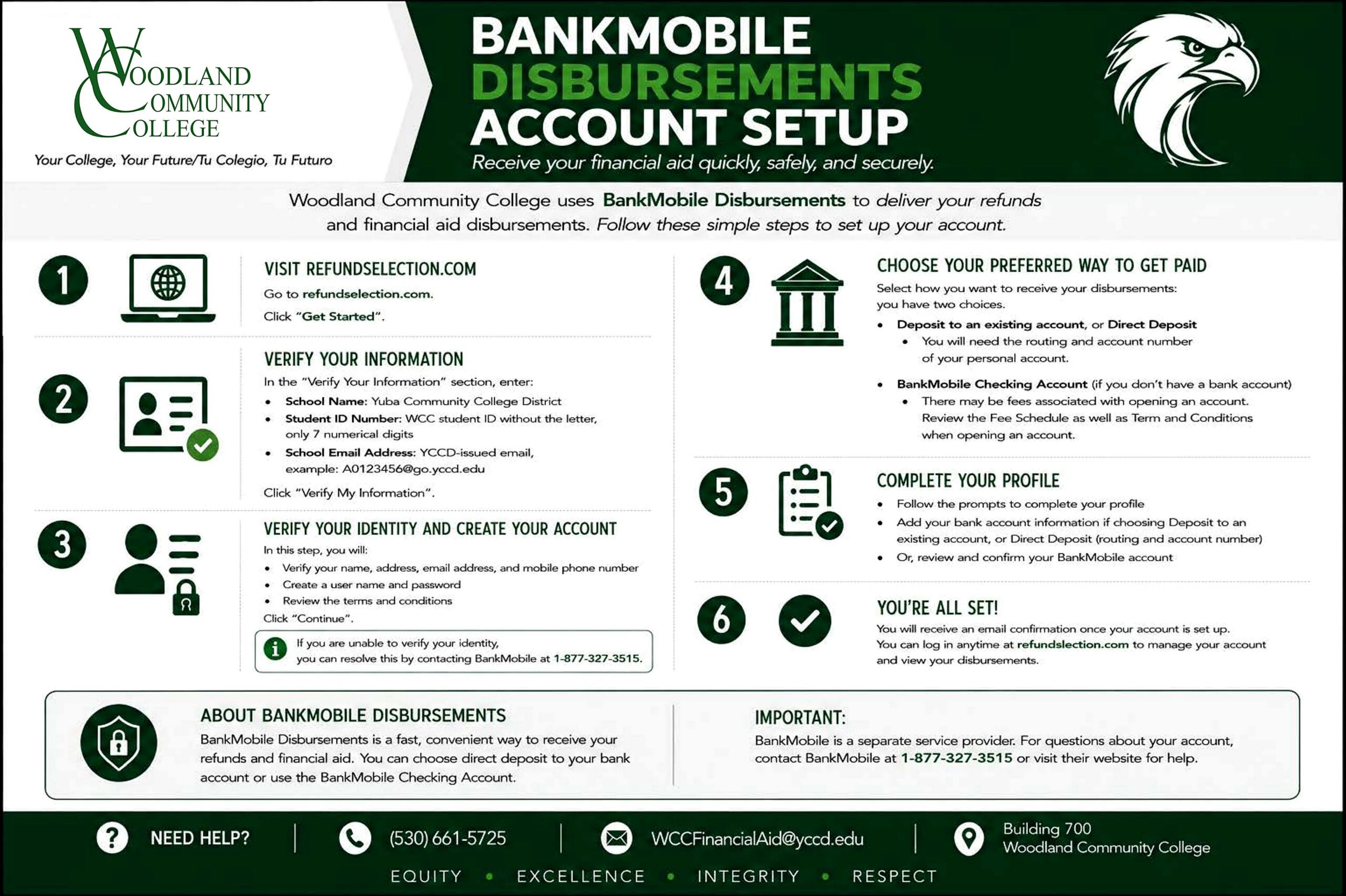
Follow Step 2 to check your required documents, review your offer letter, and choose how funds arrive.
Maintain Your Eligibility
Learn what keeps aid coming each term, and how to appeal after a loss.
Applications
Most students complete just one application. A few programs run on separate paperwork, and a small number of students end up completing more than one.
FAFSA
for U.S. citizens and eligible non-citizens
The Free Application for Federal Student Aid is for U.S. citizens, U.S. nationals, and eligible non-citizens with a valid Social Security number. One FAFSA is considered for federal grants, work-study, loans, state aid, and the WCC Promise Award. Woodland Community College’s federal school code is 041438.
| ACADEMIC YEAR | AVAILABLE | DEADLINE TO SUBMIT | TAX FILING YEAR |
| 2025-2026 (Fall 2025, Spring 2026, and Summer 2026) | December 1, 2024 | April 2, 2025 | 2023 |
| 2026-2027 (Fall 2026, Spring 2027, and Summer 2027) | October 1, 2025 | March 2, 2026 | 2024 |
| 2027-2028 (Fall 2027, Spring 2028, and Summer 2028) | October 1, 2026 | March 2, 2027 | 2025 |
California Dream Act Application
for AB 540 and undocumented students
The CADAA is for AB 540 eligible and undocumented students, including DACA recipients. It is a California application and is unrelated to the federal DACA program. Completing it opens access to state grants, fee waivers, the WCC Promise Award, and district scholarships.
| ACADEMIC YEAR | AVAILABLE | DEADLINE TO SUBMIT | TAX FILING YEAR |
| 2025-2026 (Fall 2025, Spring 2026, and Summer 2026) | December 1, 2024 | April 2, 2025 | 2023 |
| 2026-2027 (Fall 2026, Spring 2027, and Summer 2027) | October 1, 2025 | March 2, 2026 | 2024 |
| 2027-2028 (Fall 2027, Spring 2028, and Summer 2028) | October 1, 2026 | March 2, 2027 | 2025 |
California College Promise Grant
forms for students who don't plan to file a FAFSA or CADAA
The CCPG waives per-unit enrollment fees at any California community college. Eligibility is usually established automatically through the FAFSA or CADAA.
This separate application is only needed by students who are not filing a FAFSA or CADAA application.
2025-2026 – Summer 2025, Fall 2025, & Spring 2026
CCPG Application Instructions
CCPG Method B Income Standards
CCPG application – Spanish
CCPG application – English
Loss of CCPG Appeal Form
2026-2027 – Summer 2026, Fall 2026, & Spring 2027
CCPG Application Instructions
CCPG Method B Income Standards
CCPG application – Spanish
CCPG application – English
Loss of CCPG Appeal Form
Apply for the CCPG
Online Version
CalVet Fee Waiver
For Spouses, Children, and Surviving Partners of Veterans
This waiver covers enrollment fees for dependents and surviving spouses of veterans with a service-connected disability. Eligibility is determined by the California Department of Veterans Affairs, not by the college.
- Apply at a County Veterans Service Office using form DVS 40, along with the veteran’s discharge papers, VA disability rating, proof of dependency, and income documentation. The county office is a government agency separate from the college. You are allowed to use any CVSO in the state; it does not strictly have to be your home county.
- Wait for the authorization letter. The county office reviews the application and issues a letter once eligibility is approved. This can take several weeks.
- Complete the WCC CalVet Fee Waiver Questionnaire linked below, or request a copy from the Financial Aid Office.
- Turn in the authorization letter and questionnaire together at the WCC Veterans Service Office. Updated award information is sent to the student’s YCCD email once the Financial Aid Office finishes awarding.
Authorization letters cover one academic year and must be renewed. Applying in spring for the following year avoids delays. This waiver is generally only needed by students who do not already qualify for a California College Promise Grant.
Form DVS 40
Complete first, and submit to a County VSO
YCCD CalVet Fee Waiver Questionnaire
Complete and turn in with your authorization letter
District Foundation Scholarships
for all students, one application
One application through the Yuba Community College District Foundation is considered for every scholarship a student qualifies for. Awards are funded by the college, alumni, and private donors, and financial need is a factor for some but not all.
Check on My Aid Disbursement
Required documents, offer letters, and disbursement dates are all visible in Self-Service.
Fall 2026 Payment Schedule & Spring 2027 Payment Schedule
Check Your Cal Grant and/or Chafee Grant Status
Something Changed Since I Applied
An aid award reflects the financial picture at the time the application was filed. When that picture changes, or when a cost arrives that no award anticipated, there are two separate paths.
Professional Judgement
for a significant change in finances
Finances that shift after an application is filed can sometimes be reconsidered. The Financial Aid Office may be able to adjust an award for loss of income, the death of a parent or spouse, divorce or separation, or unusually high medical bills, among other circumstances. This review is called a Professional Judgement, and it starts with a conversation rather than a form. Documentation of the change is required, and not every request results in an adjustment.
Emergency Funds
for an urgent, short-term expense
A rent shortfall and other situations can put an entire term at risk. Emergency funding is requested through a district form and moves on a much faster timeline than a financial aid award. It is available whether or not a student receives financial aid.
The WCC Foundation Emergency Grant supplies emergency funds for students in need.
Dorothy Minges Student Emergency Funds are intended to meet one-time emergency needs, up to $200 per semester to students enrolled at Woodland Community College (Colusa, Lake or Woodland).
All applications will be reviewed by Woodland Community College administrative team and a response will be provided within 7 business days.
Emergency fund disbursement will be made via check to the individual requesting or service provider, when possible, directly from Yuba Community College District office and mailed to the address for you we have on record.
Please note, our funding source is limited and the extend of support is based on the type and amount of need.
Emergency Fund Request
Dorothy Minges Student Emergency Fund
Earn Money While Enrolled
Some aid is earned through work rather than awarded outright. On-campus Federal Work-Study positions, paid community service fellowships, and employer-funded tuition benefits are all available to qualifying students.
Money Skills
Budgeting, borrowing, and credit decisions made now shape what a degree costs later. Short video explainers cover common financial aid questions in a few minutes each.
Financial Literacy Tips
Skills to build a good relationship with your money
Tax Forms
The IRS Form 1098-T reports tuition paid during the calendar year and may support a tax credit. It is issued annually by the Yuba Community College District office rather than by the college, and district services handles questions about the form and corrections to it.
Appointments & Zoom
The best way to talk to our financial aid technicians is to schedule a time to meet on Zoom or over the phone.
Privacy Note: Due to Federal Privacy Regulations, we can only disclose personal information about your file if we first verify your identity or if you contact us using your Woodland Community College Email.
Locations & Hours
Woodland Campus
WCC Financial Aid Office
Visit us in Building 700
WCCFinancialAid@yccd.edu
Fax: (530) 661-1571
Due to Federal Privacy Regulations, we can ONLY disclose personal information about your file via email if you contact us using your WCC College Email.
Fall & Spring Hours
Mon
–Tue
8:00 am
–6:00 pm
Wed
–Fri
8:00 am
–5:00 pm
Lake County Campus
LCC Financial Aid Office
Visit us in Building 100
Fall & Spring Hours
Mon
–Fri
8:00 am
–5:00 pm
Our Staff
Financial Aid Staff
Program Lead
Links & Resources
FAQs
To qualify for financial aid at Woodland Community College, you’ll need to meet some basic requirements—though the exact rules can vary depending on the type of aid.
In general, you must:
- Be enrolled in a financial aid–eligible program
- Show financial need (for most programs)
- Be a U.S. citizen or eligible non-citizen
- Meet Satisfactory Academic Progress (SAP) standards
- Use your aid only for educational expenses
- Not be in default on any federal student loans
- Not owe money back from a previous federal grant
- Have a high school diploma, GED, or equivalent
- Not already have a bachelor’s degree
California students: If you’re undocumented but qualify for AB 540, you may be eligible for state financial aid through the California Dream Act.
Need help figuring it out? The Financial Aid Office can walk you through your options and make sure you’re on the right track.
No, you don’t have to be full-time to get financial aid—but the amount you receive may depend on how many units you’re taking. Some types of aid, like the Pell Grant, can be awarded to students enrolled half-time or even less. However, taking fewer classes might reduce your award and could affect your progress toward a degree.
If you’re unsure how your enrollment level affects your aid, check with the Financial Aid Office—they can help you understand what you qualify for.
We recommend you apply for financial aid as soon as you can to avoid needing to pay for any classes up front out of your own pocket.
The Free Application for Federal Student Aid (FAFSA) and California Dream Act Application (CADAA) are both applications for financial aid.
You should complete only one of these applications based on your citizenship status:
- Complete the FAFSA application if you have one of the following U.S. citizenship statuses:
- U.S. citizen
- Permanent resident
- Eligible non-citizen
- T visa holder
- Undocumented students and the following may be eligible to complete the California Dream Act application
- Be undocumented
- Have a valid or expired DACA status
- Be a U visa holder
- Have Temporary Protected Status (TPS)
- Meet the non-resident exemption requirements under AB 540
DACA does not prevent students from applying for financial aid. California students who have applied for or received approval for Deferred Action should complete the CADA Application (CADAA), and NOT the Free Application for Federal Student Aid (FAFSA).
View this help article for an in-depth comparison between the FAFSA and CADAA.
Lake County Campus and Colusa County Campus are part of Woodland Community College, so you should list Woodland Community College on your financial aid application. The school code is the same: 041438.
You’ll need to provide federal tax return information for the “prior-prior” year. For example, for the 2024–25 FAFSA, you’ll report 2022 tax information. This usually includes:
- IRS 1040 tax return
- W-2 forms (if applicable)
- Records of untaxed income (such as child support received, veterans’ non-education benefits, etc.)
The FAFSA may allow you to transfer your tax information directly using the IRS Direct Data Exchange, which is the safest and easiest way to provide accurate info.
If you’re a dependent student, yes—you’ll need to provide your parents’ income and tax information on your FAFSA or CADAA. This applies even if you don’t live with them or they don’t help you financially.
If you have unusual circumstances (like estrangement, safety concerns, or lack of contact), you may be able to request a dependency override through a professional judgment process. Contact the Financial Aid Office to discuss your options.
Normally, students under 24 are considered dependent and must include parent information on the FAFSA. But if you’re in a situation where you can’t provide that information—for example, due to estrangement, safety concerns, or other special circumstances—you may still be able to apply for aid as an independent student.
Here are some common situations where this might apply:
I have no contact with my parents.
If you’re estranged from your parents and can’t reasonably get in touch with them, you may qualify for a special review. You’ll need to explain your situation to the Financial Aid Office and may be asked to provide documentation from a third party (like a counselor, teacher, or social worker).
My parents are unavailable.
If your parents are incarcerated, living in another country, or otherwise unreachable, you may still qualify for a professional judgment to be considered independent. Be ready to share any documents that can support your situation, such as legal records, communication barriers, or letters from professionals familiar with your case.
Contacting my parents puts me in danger.
If reaching out to your parents would expose you to emotional, physical, or psychological harm, let the Financial Aid Office know. Your safety comes first, and there is a process in place to support students in dangerous or abusive situations. You’ll be asked to submit a written explanation and, if possible, statements from someone who can verify your experience (like a counselor, social worker, or police report).
What’s the next step?
In any of these cases, you can request a professional judgment—this is a special review by the Financial Aid Office to determine if you can be considered an independent student. If approved, your financial aid eligibility will be based only on your income and education-related expenses.
Reach out to us. We’re here to help, and your situation will be handled with care and confidentiality.
If you’re undocumented, a Dreamer, or a non-citizen who meets AB 540 requirements, you can still get help paying for college—even if you’re not eligible for federal aid.
Undocumented students may qualify for:
- EOPS, CARE, and CalWORKs programs – for students with additional financial or educational needs
- Woodland Community College Foundation scholarships – open to all students, including undocumented
- Woodland Community College Promise Program – may cover fees and support services for first-time students
- California College Promise Grant (formerly the BOG Fee Waiver) – helps cover tuition fees
- Cal Grants – state-funded grants for eligible students
- Chafee Grant – for current or former foster youth
- Student Success Completion Grant – for full-time students with a Cal Grant
- California Dream Act Service Incentive Grant (DSIG) – for students who volunteer in their community
- Outside scholarships – including many listed on ImmigrantsRising.org that don’t require a Social Security number or U.S. citizenship
To access most of these resources, you’ll need to fill out the California Dream Act Application (CADAA) instead of the FAFSA.
If you’re not sure where to start, contact the Financial Aid Office or find support staff in our Guide for Undocumented Students & Dreamers—we’re here to help and your information will remain confidential.
I’m concerned about sharing sensitive information in my financial aid application. Is my information safe?
We understand your concerns, and your privacy matters. To determine your eligibility for financial aid, you’ll need to provide personal and financial information—such as income, assets, household size, and number of family members in college—on your FAFSA or California Dream Act Application. This information helps calculate your financial need and determine what types of aid you may qualify for.
Your data is securely processed by either the U.S. Department of Education (for FAFSA) or the California Student Aid Commission (for Dream Act applications). Student and parent information is protected by strict federal and state privacy laws, and schools must follow information security guidelines to safeguard your data.
If additional documentation is needed, Woodland Community College will notify you through Self-Service—our secure online portal.
Note: Information submitted through the *California Dream Act Application is never shared with federal immigration agencies or federal databases.
If you have questions about what’s required or how your information is used, the Financial Aid Office is here to support you confidentially.
No. The California Dream Act Application (CADAA) is not related to the federal Deferred Action for Childhood Arrivals (DACA) program.
CADAA is used to apply for state financial aid in California (like the Cal Grant or California College Promise Grant) for eligible undocumented students, including some with or without DACA status.
You do not need to have DACA to apply for financial aid through the California Dream Act.
For more information or help applying, contact the Financial Aid Office or Undocumented Student Support.
Woodland Community College school officials are legally required to keep immigration status confidential, so students can seek help without worry.
When applying for state financial aid, the California Student Aid Commission has strict security and confidentiality policies and procedures in place to protect the integrity and confidentiality of student records.
The California Student Aid Commission has not now, or in the past, shared any information which would indicate a student’s immigration status, either documented or undocumented.
The California Student Aid Commission also adheres to the Family Educational Rights and Privacy Act (FERPA) (20 U.S.C. § 1232g; 34 CFR Part 99), a Federal law that protects the privacy of student education records.
A hold will be placed on your account, preventing some or all of your financial aid from being awarded.
If you’re undocumented and you incorrectly complete the FAFSA, the Department of Homeland Security (DHS) will prevent all financial aid from being awarded. This is because you are required to have proof of citizenship or lawful presence (per FAFSA) in order to release the hold.
If you’re not eligible for AB540/SB68 status, and you complete the CA Dream Act Application, a Residency Hold will prevent all state financial aid from being awarded. AB 540/SB 68 status will be required to release the hold.
Woodland Community College’s Federal School Code is 041438. You’ll need this number when completing your FAFSA or California Dream Act Application to make sure your financial aid information is sent to Woodland Community College.
External Links
FAFSA Application
Apply for federal financial aid
California Dream Act Application
State aid for undocumented students
Federal Student Aid Portal
Manage loans, grants, and FAFSA
California Grant Info
Check Cal Grant status online
BankMobile Refunds
Select how aid is disbursed